About the Seed Library
Spring 2026 Update: Seeds are available and are restocked on a rolling basis.
Our seed library provides free seeds for the use of our community. You do not need to have a Portage District Library card to participate. Please only take what you can plant and consider “returning” seeds to the seed library for others to borrow by saving seeds, donating commercially purchased seeds, or making a designated monetary donation to support this service.
 Seeds are located in the large green card catalog between the Heritage Room and the Makerspace on the main level.
Our selection of available seeds is constantly changing.
Some plants can cause negative or adverse reactions in humans or animals. It is your responsibility to educate yourself about the plants you are considering adding to your landscaping. Please check the ASPCA for guidance about toxic plants.
Where do I find the seeds in the Library?
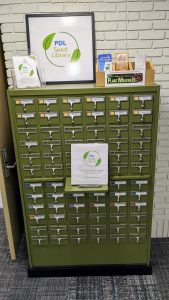
The seeds are located in the large green card catalog between the Heritage Room and the Makerspace at the back of the library on the main level.
Our seeds are organized into six color coded categories:
 Vegetables
  Herbs
Herbs  Annuals
  Michigan Native
  Shrub/Tree
Ready to get started? Here’s how it works.
Borrow: Visit the library to select the seeds you would like to plant. These seeds are available to anyone in the community. You do not need to have a PDL library card to use this service. There is no limit on the number of seeds you can take, but PLEASE only take what you will plant.
Grow: Check out a library book on gardening, do research online, or use the resources at the bottom of this page to help your seed get the best start possible.
Save: Make sure to observe the Seed-Saving Guidelines for your particular variety. When a seed is mature, harvest, dry, and store it for use next season. If you are not able to save seeds, consider donating a few seed packets to the library so we can continue our Seed Library next year.
Return: Put your seeds in an envelope and return them to the library. Please fill out an information form with your saved seed donation. These forms are also available at the library.
Seed Collecting Guidelines for 2025-2026
We welcome you to gather a limited number of seeds from the library gardens to grow in your own space.
In the spirit of the Honorable Harvest as explained by Robin Wall Kimmerer, please take only what you need and leave enough for the wildlife.
– Collect only a what you will use.
– Use paper bags or envelopes to store your seeds.
– Be sure seeds are completely dry before storing to prevent mold.
– Make a promise to try and grow them, giving back to the land what has been so generously shared.
By practicing reciprocity, you help sustain the circle of life—caring for these plants ensures they will care for us, our pollinators, and our community in return.
Contributing to the Seed Library
We are happy to accept seed donations, especially from seed savers! So that we have adequate seed information, please fill out an information form with your saved seed donation. These forms are also available at the library.
Notes
- If you bring in seeds from varieties obtained outside of our seed library, please ensure that they are not hybrids. Hybrids will not grow true-to-type in future generations.
- If you suspect the seeds you saved for the library may have been cross-pollinated, diseased, etc., please let us know. We won’t think any less of you, but we need to know this so we can keep our seed pool as healthy as possible.
Online Resources - Michigan Native Plants
Michigan Flora provides up-to-date information about the diversity and occurrence of plants is essential to understanding and stewarding Michigan’s environment and appreciation of its natural heritage.
National Wildlife Federation – Native Plants Finder searches by zip code to find plants that host the highest numbers of butterflies and moths to feed birds and other wildlife where you live.
Prairie Moon Nursery provides the largest native plant collection available for retail sales in the United States. Use their search feature to find information about each plant’s preferred sun exposure, soil moisture, height, bloom time, germination requirements, range map, and more along with detailed photos.
Online Resources - Vegetable and Herb Gardening
MIgardener blog and MIgardener YouTube channel can help you learn how to garden easier, smarter, and have more fun gardening!
Seed Savers Exchange — Extensive and user-friendly information to expand your vegetable gardening and seed saving know-how with helpful garden tips, how-to guides, and more.
Michigan State University has an Ask Extension webpage where you can submit questions you have about gardening.
Books
New to seed-saving or gardening? Interested in learning more about growing native plants? Stop by the library, browse our collection of gardening books, or check out the links above for all your seed-y resources!
Native Plants
Vegetable Gardening
Sponsors
We are grateful for donations from Community Members, Kalamazoo Area Wild Ones, and seeds collected from the PDL Monarch Waystation.
Thanks to a generous donation from Target, we were able to have more seeds available for summer 2025 planting that could be harvested in the fall.